

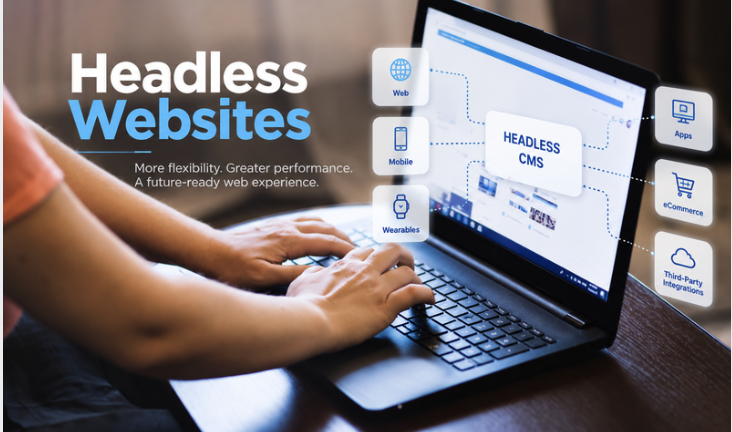
A business website can begin as a simple marketing channel and gradually become a more complex digital platform. New markets, mobile experiences, customer portals, e-commerce functions and integrations can place pressure on a conventional content management system that was originally designed mainly to publish pages.
For organisations evaluating headless websites, the attraction is greater separation between content management and the customer-facing experience. Instead of a CMS controlling both content and presentation, the content layer can operate independently while developers build the website, application or other digital experience with technologies suited to the project.
That flexibility can be valuable, but headless architecture is not automatically the right choice for every company. It normally brings additional architectural decisions, development responsibilities and integration requirements. The business case should therefore come before the technology choice.
What Is a Headless Website?
At a high level, headless websites separate the presentation layer—the interface customers interact with—from the back-end system used to manage content or commerce. The two layers communicate through APIs, allowing content and business data to be requested by different front ends.
In a conventional CMS implementation, content management and presentation are usually more tightly connected. A headless model gives developers more freedom over the front end while editors continue managing structured content in the back end.
This distinction is easier to understand when separating visual design from the engineering beneath it. The difference between web design and web development matters because headless projects require user experience, content modelling and software architecture to work together without being locked into one presentation layer.
Traditional CMS vs Headless Architecture
Neither architecture is universally better. The right choice depends on the website’s purpose and operating model.
| Decision area | Traditional CMS | Headless architecture |
|---|---|---|
| Front end | Usually closely connected to the CMS | Built independently |
| Content delivery | Primarily page and template based | Commonly delivered through APIs |
| Developer freedom | Influenced by the CMS presentation model | Greater freedom over front-end technologies |
| Multichannel content | May require additional configuration | Structured content can be reused across channels |
| Initial complexity | Often lower for standard websites | Usually requires more technical planning |
| Hosting | Often centred around the CMS | Front end and back end may use separate services |
| Best fit | Straightforward marketing or editorial sites | Complex, high-change or multichannel platforms |
Choosing a headless approach only because it sounds more modern can create unnecessary complexity. A conventional CMS can remain the better option when a company needs predictable page publishing, standard functionality and a straightforward operating model.
1. Greater Freedom Over the Customer Experience
One of the strongest benefits of headless websites is that the development team is not tied as closely to a CMS theme or built-in rendering layer.
Developers can create the customer-facing experience with a suitable framework and design system while the CMS remains responsible for managing content. This can be useful when a brand needs distinctive interactions, application-like behaviour or interfaces that differ significantly from standard page templates.
For the business, this flexibility can support more tailored user journeys, reusable design systems and greater control over responsive behaviour. However, design freedom should not create unnecessary complexity. Applying website navigation best practices remains important regardless of the front-end technology.
Technical freedom creates value only when it improves the experience or makes future development easier.
2. Reuse Content Across Multiple Digital Channels
A traditional website often organises information around individual pages. A headless content model can instead store information as structured components such as product descriptions, service details, locations, FAQs, articles or staff profiles.
This is one reason headless websites can be useful for organisations operating across several customer touchpoints. The same approved content can potentially serve a website, mobile application, customer portal or other digital interface without being rewritten separately for every channel.
For an Irish organisation expanding across European markets, structured content can also make it easier to manage consistent product or service information while allowing different front ends to present that information appropriately.
Content reuse is most valuable when the organisation genuinely has multiple channels or markets to support. A small business managing one straightforward marketing site may gain little from the extra architecture.
3. Evolve the Front End Without Rebuilding the Content Platform
Another advantage of headless websites is the ability to evolve the presentation layer with less dependence on the underlying CMS.
A company might redesign its customer interface, introduce a new front-end framework or launch an additional digital channel while keeping established content models and editorial workflows. This can be valuable where customer-facing experiences change more frequently than internal content processes.
It does not make redesigns effortless. Teams still need to consider information architecture, redirects, analytics, accessibility, testing and content quality. The indicators covered in signs that a business website needs a redesign can help leaders distinguish a genuine structural problem from a purely cosmetic refresh.
Decoupling reduces some dependencies, but it does not remove the need for disciplined product management.
4. Build a More Flexible Integration Architecture
Modern websites increasingly depend on systems outside the CMS. Customer information may sit in a CRM, product records in an ERP or commerce platform, and identity data in a separate authentication service.
With headless websites, the digital experience can be assembled from specialised services rather than expecting one CMS to provide every capability. APIs connect the front end, content platform and other systems.
This can suit organisations that need commerce, search, customer accounts, product information, payments, booking or analytics to work together. An online retailer, for example, might use a dedicated commerce engine while a separate content platform manages editorial content.
Before adopting that structure, leaders should understand the broader project cost and operational implications. The guide to e-commerce website development costs provides useful context for evaluating the complete solution rather than only the storefront.
A composable architecture replaces some platform constraints with greater integration responsibility.
5. Gain More Control Over Performance and Delivery
A further benefit of headless websites is greater control over how the front end is built, hosted and delivered.
Depending on the project, pages may be pre-rendered, generated dynamically or delivered through a combination of approaches. Teams can select infrastructure and deployment patterns that suit performance, availability and development requirements.
Headless architecture does not automatically guarantee a fast website. Poor API design, excessive JavaScript, inefficient media handling or too many third-party scripts can still create performance problems.
Hosting responsibilities also need to be clear because the front end and content platform may use separate services. Irish organisations can use the overview of website hosting costs in Ireland to frame decisions around infrastructure, support and ongoing ownership.
Performance should be designed, tested and monitored rather than assumed from the architecture label.
When Headless Architecture Makes Sense for Irish Businesses
For Irish organisations, headless websites are most compelling when the digital environment has outgrown a simple page-based site.
A headless approach may deserve serious consideration when:
- The same content must serve websites, applications or other channels.
- The front end requires highly customised interactions.
- Several specialised business platforms need to work together.
- Development teams need to evolve front-end and back-end systems independently.
- The website is becoming a digital product rather than only a marketing presence.
- The organisation expects frequent market or channel changes.
- Technical teams can maintain APIs, deployments, integrations and monitoring.
An Irish SaaS company serving several European markets, for example, might want structured product content reused across its public site and authenticated customer application. A retailer might want a custom storefront while continuing to manage catalogue, checkout and orders through a dedicated commerce platform.
These are illustrative scenarios rather than automatic reasons to go headless. Complexity must be justified by a real operational or customer-experience requirement.
When a Traditional CMS May Be Better
A comparison of headless architecture with traditional platforms should also recognise where the simpler option is stronger.
A conventional CMS may be more appropriate when the organisation mainly needs a corporate website, publishes to one primary channel, has limited integrations and wants internal teams to manage pages with minimal technical involvement.
The distinction matters because headless websites normally require stronger engineering ownership. If the organisation is unlikely to use multichannel content, specialised integrations or independent front-end development, the additional architecture may become technical overhead.
The same principle applies when deciding how often a website should be redesigned: technology change should solve a defined problem rather than follow a trend.
What Leaders Should Assess Before Choosing Headless Web Development
Before approving a headless website development project, leaders should assess six areas.
Content
Determine how content is structured, who manages it and where it needs to appear. If content reuse is central to the strategy, a headless approach may have a stronger case.
Integrations
List the platforms that need to exchange information and identify which system owns each type of data. API availability, authentication and failure handling should be understood early.
Technical Capability
Teams need a plan for front-end development, deployments, CMS configuration, integrations and monitoring. More architectural freedom usually means more engineering responsibility.
Editorial Experience
Editors need suitable workflows, previews and content models. A technically elegant system that makes routine publishing difficult creates a different business problem.
Total Cost
Compare development, CMS licensing, hosting, integrations, maintenance and future changes rather than evaluating only the first build.
Security and Governance
Clarify access permissions, API security, third-party dependencies and update responsibilities. Architecture decisions should account for the full lifecycle of the website, not only launch day.
How Dev Centre House Ireland Can Support Headless Website Development
Dev Centre House Ireland can support organisations evaluating headless websites by first determining whether a decoupled architecture is justified by the business requirements.
Discovery and requirements analysis can clarify content workflows, customer journeys, integrations, internal capabilities and future channels. Software architecture can then define the roles of the CMS, front end, APIs and other business systems before development begins.
Implementation may include headless CMS configuration, custom front-end development, API integration, commerce integration, cloud deployment, testing and performance optimisation. For an existing site, migration planning can also address content, URLs, redirects and integrations.
For organisations choosing an external partner, the criteria in choosing the right web design company in Ireland can help structure questions around technical capability, delivery approach and ongoing support.
The objective is useful flexibility without creating complexity the organisation cannot sustain.
Conclusion
The strongest case for headless websites appears when organisations need greater control over customer experiences, reusable content, independent front-end evolution, specialised integrations or delivery across several digital channels.
Those benefits come with trade-offs. Headless architecture can require more engineering, integration management and operational ownership than a conventional CMS. For a straightforward corporate website, that additional complexity may offer little return.
Irish businesses should begin by defining the digital experience they need, the systems that must connect and the way content will be managed over time. If those requirements genuinely demand a decoupled model, headless website development can provide a flexible foundation. If they do not, a well-implemented traditional CMS may remain the simpler choice.
FAQs
1. What are headless websites and how do they work?
They separate the customer-facing presentation layer from the back-end content or commerce system. APIs allow the front end to request content and data from those systems, giving developers greater freedom over how the experience is built.
2. What is the main benefit of a headless website?
The main benefit is architectural flexibility. Organisations can develop the front end independently, reuse structured content across channels and connect specialised systems without relying on one CMS for every capability.
3. Are headless architectures better for SEO?
They can support strong SEO, but the architecture itself does not guarantee better rankings. Teams still need to manage rendering, metadata, redirects, performance, structured content and other technical SEO requirements correctly.
4. Is a headless website more expensive to build?
It can require greater initial engineering and integration effort than a straightforward traditional CMS project. Total cost depends on the CMS, front-end requirements, hosting, integrations and maintenance.
5. How can Dev Centre House Ireland support a headless website project?
Dev Centre House Ireland can support discovery, requirements analysis, software architecture, headless CMS implementation, front-end development, API integrations, cloud deployment, migration planning, testing and performance optimisation.